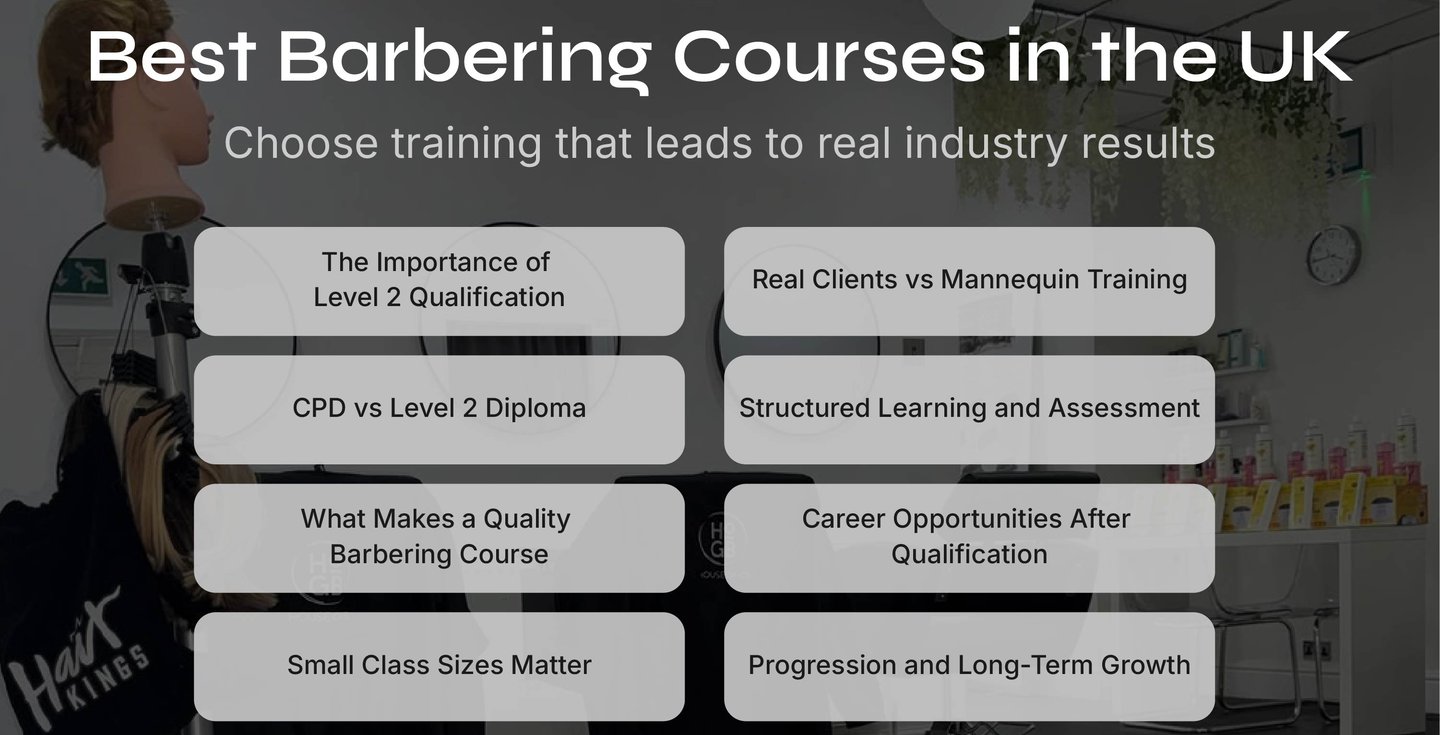
Best Barbering Courses in the UK
4/30/20265 min read
The barbering industry is full of courses. Short ones, fast ones, cheap ones, expensive ones. What most of them do not tell you upfront is whether they will actually leave you job ready. The difference between a course worth taking and one that wastes your time comes down to a handful of things: the qualification you walk away with, how much personal attention you get during training, and what support exists after you finish.
The Qualification That Matters
Why Level 2 Is the Industry Standard
A Level 2 qualification in barbering is the minimum most barbershops expect before they will take you on as a stylist. Without it you cannot get properly insured to work on clients, and most employers will not consider you for a paid role.
It is worth knowing the difference between a CPD certificate and a regulated qualification. CPD accreditation confirms a course meets a recognised training standard. A regulated Level 2 sits on the Ofqual register and carries formal industry recognition across the board.
Both have value. But if working professionally as a barber is the goal, the regulated qualification is what you need. It is what makes you employable and insurable from day one.
The Level 2 Diploma in Barbering at House of GB
The Level 2 Diploma in Barbering at House of GB is a Focus Awards RQF qualification, Ofqual regulated and CPD accredited. It runs one 8-hour day a week over 47 weeks, with 376 learning hours in total, covering everything the industry expects: shampooing and conditioning, client consultation, health and safety in the salon, shaping and cutting facial hair, and cutting men's hair using core barbering techniques. Assessment runs across the full course through observation, practical work, assignments, and oral questioning. There are no specific entry requirements beyond being 16 or over. 0% finance is available, and a £200 deposit secures your place.
On completion, you receive a recognised Level 2 Diploma in Barbering. The natural next step from there is the Focus Awards Level 2 Diploma for Hair Professionals in Hairdressing, which broadens your skill set further if you want it.
What Separates Good Barbering Training from Average
Class Size and Personal Attention
This is the detail most course pages bury or skip entirely. A room with fifteen students and one instructor means you spend a lot of time waiting, watching, and not actively cutting. Barbering is a hands-on skill. The only way to get better is to do it repeatedly, with someone experienced enough to correct what you are doing wrong before bad habits set in. Small class sizes change the quality of training completely.
You get more time on the tools, more direct feedback, and more confidence built session by session. It is the single biggest practical difference between a course that produces job-ready barbers and one that produces people who technically completed a programme but struggle the moment they are behind a real chair with a real client.
Real Clients vs Mannequin Heads
Mannequin heads have their place early in training. But they do not move, they do not have opinions, and they do not reflect the range of textures, densities, and growth patterns you will encounter when you start working with real people.
Courses that keep students on mannequins for too long produce barbers who struggle the moment a real person sits down. Training on live clients is where the actual skill gets built. You learn to read hair, manage expectations, and work at a professional pace.
When evaluating any barbering course, ask directly how much of the training involves live clients and how early that starts. The answer tells you almost everything you need to know about the quality of what you are buying.
Ongoing Support After You Finish
Most courses end on the last day of training and leave you to figure out the rest alone. That gap between finishing a programme and feeling genuinely confident working independently is where a lot of newly qualified barbers struggle. Questions come up constantly in the early weeks of professional work, and without somewhere to turn, uncertainty sets in fast. At House of GB, ongoing support and advice are built into the training from the start, and they do not stop when the course does.
For anyone moving into barbering from a completely different background, that continuity makes a real practical difference to how quickly you settle into the work.
What You Can Do After You Qualify
Working in a Barbershop
A Level 2 Diploma opens the door to employed barbershop work straight away. You go in as a qualified professional, not a trainee, which matters for the roles available to you and what you can expect to earn from the start.
The experience you build in a busy shop, working across different hair types and client needs every day, turns a solid qualification into a genuinely strong skill set. Most barbers who end up running their own places spent real time in employment first.
It is how the craft develops. The diploma gets you in. The work that follows is what builds the career.
Going Freelance or Opening Your Own Shop
Some barbers qualify and go straight to working independently. Chair rental, mobile barbering, and home studio setups. All of it becomes possible once you hold a recognised qualification and the insurance that comes with it. The income takes longer to build that way, but the freedom is genuine and the earning ceiling is higher once a solid client base is in place.
Opening a full shop is a bigger commitment, and most people take that step after several years of experience rather than straight after qualifying. But the diploma is where that path begins. Without the recognised qualification, none of the routes into self-employment are properly open to you.
Teaching Barbering with the Level 3 Award in Education and Training
Qualified barbers who want to move into teaching have a direct route through the Level 3 Award in Education and Training at House of GB. It is an Ofqual-regulated Focus Awards qualification, the same programme previously known as PTLLS, and it qualifies you to teach any subject you already hold a qualification in. For a qualified barber that means you can teach barbering professionally. The course runs 12 weeks, Monday mornings 9am to 1pm, with an online option over six months for those who need the flexibility. Groups stay at eight students maximum, no prior teaching experience is needed, and Klarna plus monthly payment options are available.
It is a completely different dimension of the same career. Stability, variety, and the chance to shape the next generation of barbers coming through the industry.
Frequently Asked Questions
Do you need a qualification to become a barber in the UK?
There is no legal requirement, but in practice, you need at least a Level 2 to get insured and to be considered for most barbershop roles. Without it, working professionally with clients is not a realistic option.
How long does the Level 2 Diploma in Barbering take at House of GB?
One 8-hour day a week over 47 weeks, with 376 total learning hours. Structured to build skill steadily rather than rushing content through in a compressed format.
What is the difference between a CPD certificate and a Level 2 Diploma?
CPD accreditation confirms a course meets a recognised training standard. A Level 2 Diploma is a regulated qualification on the Ofqual register, which is what most employers require and what you need to get properly insured as a barber.
Can I teach barbering after qualifying?
Yes. The Level 3 Award in Education and Training at House of GB qualifies you to teach it professionally once you hold the barbering qualification. Twelve weeks, no prior teaching experience required.
What are the entry requirements for the Level 2 Diploma in Barbering?
No specific entry requirements. You need to be 16 or over. The course takes complete beginners through to a professional standard qualification.